

PPGI Coil Gloss, Hardness and T-Bend Performance: A Buyer’s Guide
PPGI Coil Gloss, Hardness and T-Bend Performance: A Buyer’s Guide
PPGI coil performance tests translate coating behavior into inspectable evidence. Gloss describes reflected appearance, pencil hardness screens surface resistance, T-bend and adhesion checks probe deformation behavior, and impact testing examines how the coating responds to sudden strain.
None of these results should be ordered as a floating number. A useful requirement identifies the test method, specimen preparation, conditioning, direction, acceptance criterion, sampling plan and reporting format. This guide helps buyers state those details and review inspection reports without treating unlike methods as interchangeable.
The Direct Answer
Choose tests from the forming process and visible-service risk. Specify gloss when appearance consistency matters; hardness when handling and surface marking are concerns; T-bend when the product will be folded or roll formed; adhesion when coating separation must be evaluated; and impact resistance when fabrication or handling may impose localized deformation.
1. What Each PPGI Performance Test Actually Tells You
| Test | Primary question | Useful for | Does not prove by itself |
|---|---|---|---|
| Gloss | How strongly does the surface reflect light under a defined geometry? | Appearance, panel matching and visual consistency | Color accuracy, weathering life or adhesion |
| Pencil hardness | How does the paint surface respond to scratching or gouging under the stated method? | Handling resistance and comparative coating control | Formability, impact resistance or outdoor durability |
| T-bend | Can the coated sheet tolerate a defined bend without unacceptable cracking or loss of adhesion? | Profiles, flashings, folded parts and forming review | Performance in every tooling radius or process |
| Adhesion | Does the paint remain attached after a defined cut, tape or deformation procedure? | Coating-system control and failure screening | Long-term corrosion resistance on its own |
| Impact resistance | How does the coating respond to rapid localized deformation? | Handling damage and fabrication screening | Slow-bend formability or full part qualification |
These tests complement one another because appearance, surface strength and deformation behavior are different properties. A harder coating is not automatically more formable, and a flexible coating is not automatically resistant to scratching. The correct balance depends on the specified substrate, metallic coating, pretreatment, primer, topcoat, back coat and intended process.
2. PPGI Gloss Level: Define More Than a Target Number
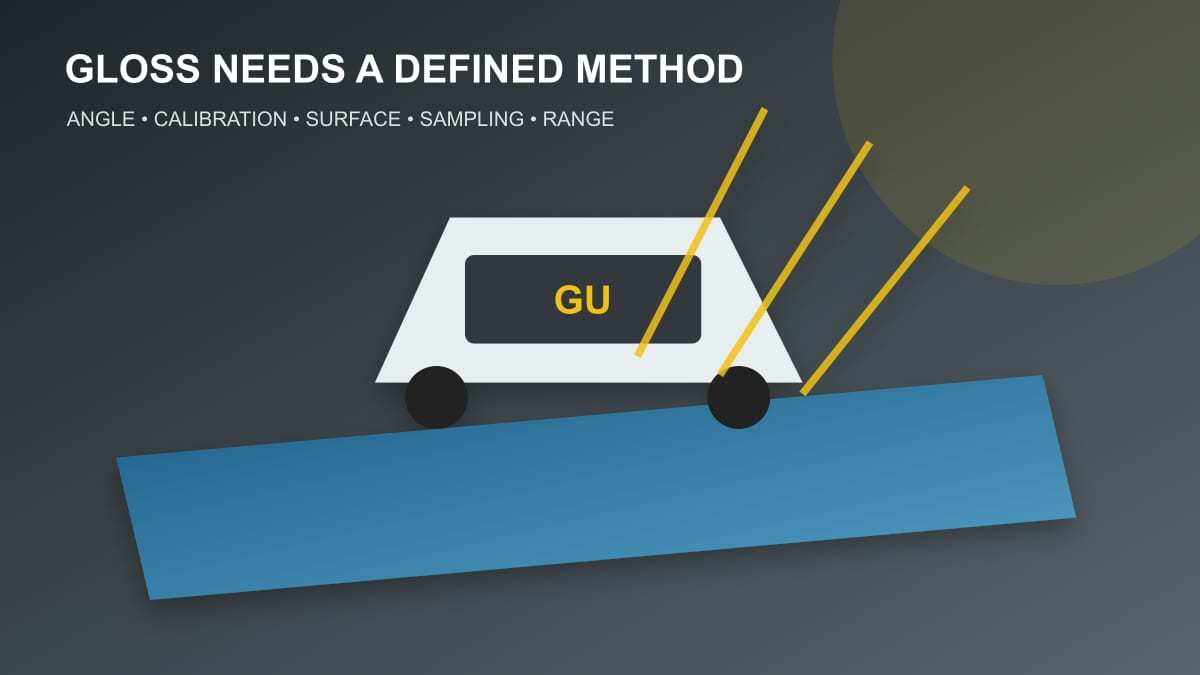
A gloss meter directs light onto the coated surface and measures reflected light at a defined geometry. Results are commonly expressed in gloss units, but values produced with different geometries or procedures should not be compared as though they were the same measurement.
What affects the reading
- Measurement geometry and instrument calibration
- Surface texture, embossing and paint formulation
- Film uniformity, cure and specimen flatness
- Measurement direction and location
- Cleanliness, scratches and local surface defects
What buyers should specify
- Referenced method and measurement geometry
- Target range rather than an ambiguous label alone
- Approved sample or master where appearance is critical
- Number and distribution of readings
- How coil-to-coil variation will be judged
Terms such as low gloss, matt, semi-gloss and high gloss can help describe appearance, but they are not universal acceptance limits. Link any verbal category to the agreed data sheet, approved sample and instrument method. Also keep gloss separate from color difference: two panels can have similar color coordinates yet appear different because their gloss or texture differs.
3. Pencil Hardness: A Comparative Surface Test
In a pencil hardness procedure, pencils of graded hardness are prepared and moved across the coating under a specified setup. The reported endpoint may refer to gouging, scratching or another criterion defined by the chosen method. Buyers should state the endpoint because two reports can use the same pencil designation while judging different surface changes.
- 01
Confirm the test method
Cite the exact standard and edition. Do not assume a similarly named method uses identical preparation, angle, load or endpoint.
- 02
Condition the specimen
Paint cure, specimen temperature and conditioning time can influence the result. The report should identify relevant conditions.
- 03
Prepare the pencil consistently
Lead exposure, face preparation and pencil condition need to follow the selected method. Irregular preparation creates operator-dependent results.
- 04
Identify the failure criterion
Record whether the endpoint is a scratch, gouge, rupture or another defined observation rather than reporting only a grade.
Pencil hardness is valuable for production comparison when the method and operator practice are controlled. It should not be presented as a direct conversion to coating flexibility, abrasion life or another hardness scale. If handling damage is a major concern, combine it with relevant adhesion, impact and visual inspection requirements.
4. PPGI T-Bend Test: Connect the Result to Forming
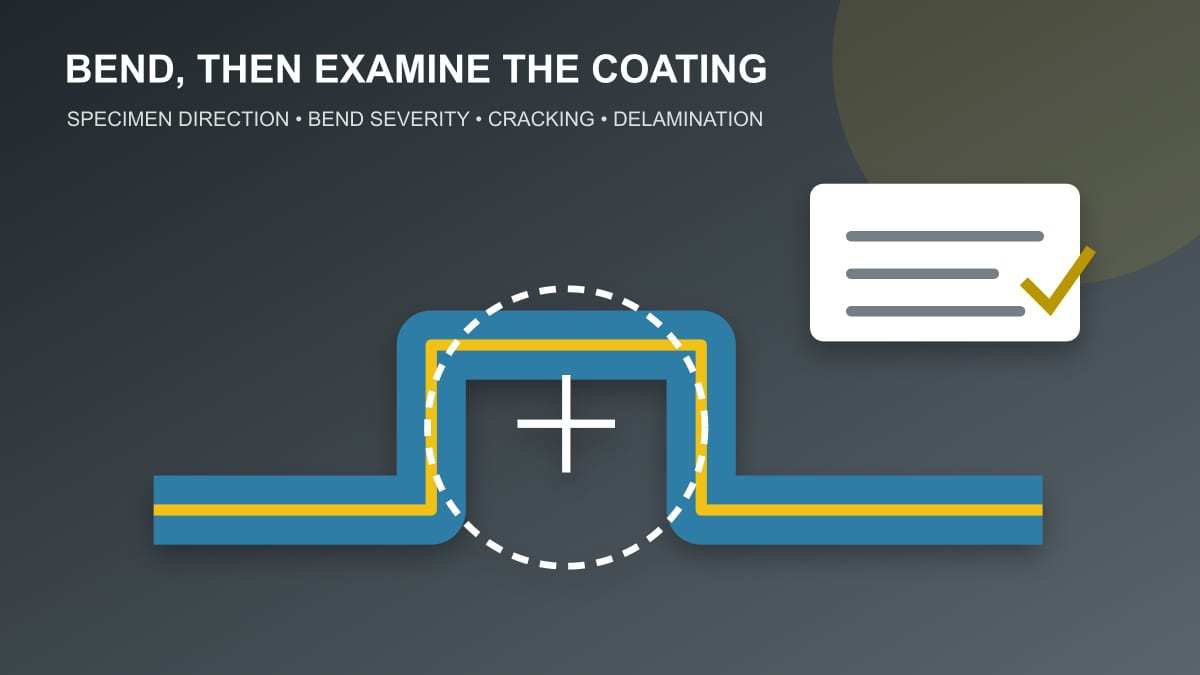
The PPGI T-bend test folds a coated specimen through a defined sequence or around a thickness relationship specified by the chosen method. After bending, the test area is examined for coating cracking, loss of adhesion or another stated defect. The result helps screen whether the coating system can tolerate deformation, but it does not reproduce every roll-forming line or part geometry.
Specimen direction
Orientation relative to the rolling direction can affect deformation. State how specimens are cut and report the direction.
Bend severity
The meaning of a T designation belongs to the referenced procedure. Do not compare labels from different methods without reviewing their definitions.
Examination method
Visual examination, magnification, tape application or other checks must follow the agreed procedure.
Acceptance criterion
Define what counts as unacceptable cracking, peeling or delamination and whether edge effects are excluded.
For demanding profiles, use the laboratory result as one input and conduct representative forming trials with production tooling. Tool radius, line speed, lubrication, temperature, substrate properties and profile sequence may change real processing behavior.
5. Adhesion Tests Need a Named Procedure
“Good adhesion” is not a measurable purchase requirement. Adhesion can be evaluated with a cut pattern and tape, after bending, after impact or through another procedure. Each approach stresses the coating differently, so the PO should name the method, classification scale and acceptance threshold.
- Cut pattern: spacing and number of cuts may depend on coating thickness and method.
- Cutting tool: blade condition and cut depth can influence the apparent result.
- Tape: type, storage, application pressure and removal timing should follow the method.
- Assessment: use the method’s classification language and retain clear photographs where practical.
- Location: avoid unrepresentative damaged areas unless the purpose is to investigate that damage.
An adhesion result does not establish corrosion durability by itself. Pretreatment, metallic coating, paint chemistry, film thickness, cure and exposure all contribute to service performance. Keep adhesion evidence tied to the exact coil and coating system represented by the order.
6. Impact Resistance: Sudden Deformation Is a Separate Risk
Impact testing applies a controlled strike to a coated specimen and then examines the deformed area. Depending on the specified method, the evaluation may involve cracking, detachment, tape assessment or another failure criterion. Direct and reverse impact configurations may stress the coating differently.
State in the PO
- Exact method and edition
- Direct or reverse configuration
- Specimen support and impact conditions
- Acceptance energy or classification as defined by the method
- Post-impact examination procedure
Check in the report
- Equipment identification and verification status
- Specimen ID, orientation and conditioning
- Actual test setting, not only the target
- Observed cracking or detachment
- Pass/fail against the contractual criterion
Do not infer an impact value from pencil hardness or T-bend performance. A coating can respond differently to a rapid localized strike than to slow bending or surface scratching.
7. Build a Test Schedule Around the End Use
| End-use concern | Priority evidence | Additional buyer check |
|---|---|---|
| Visible roofing or wall panels | Gloss range, color control and surface inspection | Approve representative samples under agreed viewing conditions |
| Tight folded flashings | T-bend and adhesion after deformation | Trial the actual bend radius and tooling where risk is high |
| Roll-formed profiles | T-bend, adhesion and mechanical-property data | Review line geometry, direction and forming sequence |
| Frequent handling or fabrication | Pencil hardness, impact and visual defect criteria | Define protective film and packaging separately if needed |
| Appearance-critical matched elevations | Gloss distribution plus agreed color-difference control | Plan batch allocation and installation direction |
A longer list of tests is not automatically a better specification. Select tests that control a real risk, and avoid combining demanding limits copied from unrelated coating systems. If a buyer requires several properties simultaneously, ask the supplier to confirm that the combination is achievable for the specified paint chemistry and forming requirement.
8. How to Write the Purchase Order Requirement
Use a structured clause instead of isolated values:
Product identity: PPGI substrate, metallic coating, pretreatment, primer, topcoat, back coat and finish as separately agreed.
Gloss: target range, geometry, method and edition, sampling locations and approved reference sample where applicable.
Pencil hardness: method and edition, specimen conditioning, endpoint definition and minimum accepted classification.
T-bend: method and edition, specimen direction, bend procedure, examination method and acceptance criterion.
Adhesion and impact: named procedures, configurations, classification scales and acceptance thresholds.
Sampling: number of coils, specimens per coil, location rules, lot definition and retest procedure.
Evidence: raw readings, observations, equipment identification, test date and traceability to coil numbers.
Replace every general placeholder with the actual contract requirement. Do not claim that two standards, methods or classifications are equivalent unless a technical review supports that conclusion and the agreement states how conflicts will be resolved.
9. Review the Inspection Report Before Shipment
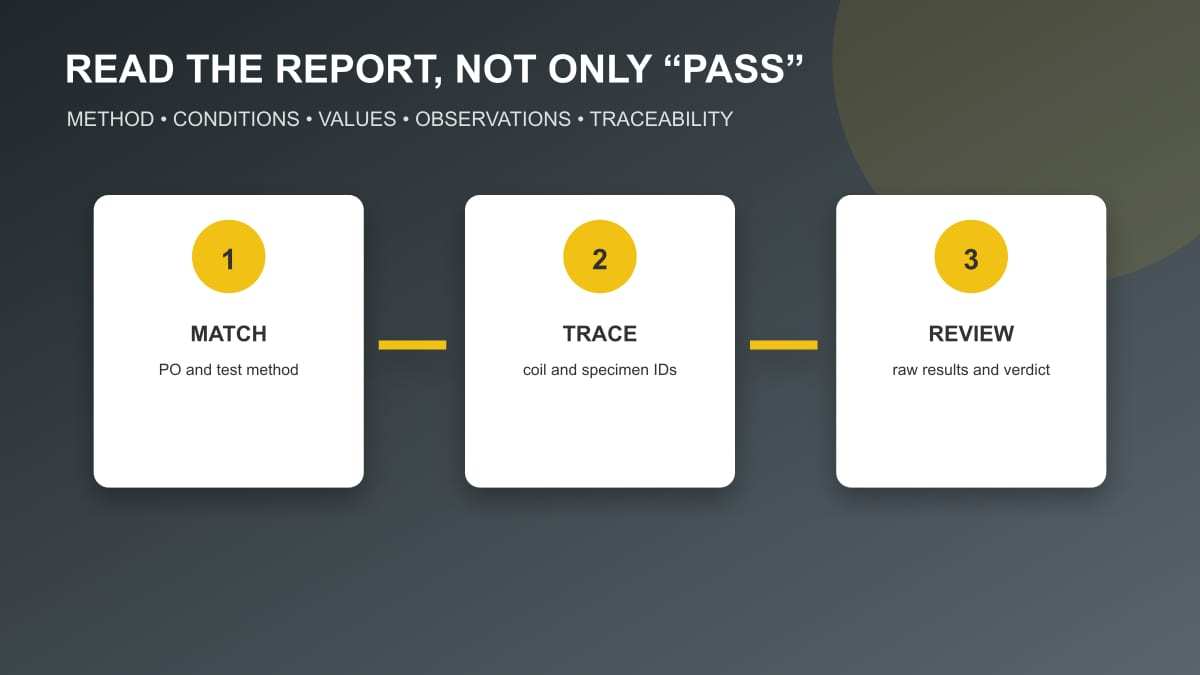
A one-line certificate entry saying “pass” provides little diagnostic value. A useful PPGI coil performance report lets the buyer reconstruct what was tested and compare it with the PO.
Contract match
Are the method, edition, geometry, direction, endpoint and acceptance limit identical to the purchase order?
Traceability
Do specimen IDs link to coil numbers, production lots, labels and packing documents?
Test conditions
Are conditioning, equipment, calibration or verification status and relevant setup details recorded?
Raw evidence
Are individual gloss readings, hardness observations, bend results and impact settings visible?
Failure description
If a specimen fails, does the report distinguish cracking, peeling, delamination, scratching and other observations?
Disposition
Is any retest, concession or lot segregation documented and authorized under the agreed procedure?
Photographs are useful for bend, adhesion and impact observations, provided they are legible and traceable. They support—not replace—the measured data, method record and signed inspection conclusion.
Common Buyer Mistakes
- Using gloss terminology without a measurement geometry, range or approved sample.
- Reporting pencil hardness without identifying whether scratch or gouge is the endpoint.
- Treating a T-bend label as universal across all test methods.
- Assuming high hardness means good formability or good impact resistance.
- Accepting averages when the contract limits individual readings or local defects.
- Requesting several aggressive limits without checking whether the combination suits the selected paint system.
- Reviewing only “pass/fail” and not the raw values, observations and coil traceability.
Frequently Asked Questions
Is a higher PPGI gloss level always better?
No. Gloss is an appearance choice and control parameter, not a general quality ranking. The suitable range depends on the finish, application, approved sample and visual design.
Does higher pencil hardness mean the coating is more durable outdoors?
Not by itself. Pencil hardness screens surface response under a defined procedure. Outdoor durability depends on the full coating system, exposure and other properties.
Can a T-bend result guarantee trouble-free roll forming?
No. It is a useful comparative and acceptance test, but actual forming also depends on tooling, radius, speed, direction, lubrication, temperature and material properties. Representative trials may still be needed.
Should every PPGI order include every performance test?
No. Select tests from the application risk and contractual coating system. Unnecessary or incompatible limits can add cost without improving fitness for use.
Can results from different standards be compared directly?
Only after reviewing specimen preparation, equipment, geometry, procedure, endpoint and classification. Similar test names do not establish equivalence.
Final Buyer Checklist
Before approving a PPGI order, connect every required property to a named method, defined conditions, sampling plan and acceptance rule. Review gloss, pencil hardness, T-bend, adhesion and impact as distinct evidence, then verify that the report records raw results and coil traceability. This performance-testing approach complements paint-system selection without repeating it.
Continue with the Steel Plate & Coil Guide for related procurement topics.